What is a stop loss?
A stop loss is an exit level decided before you enter. For a long trade it sits below the entry; for a short, above. When the price reaches it, you exit — ideally with an order already sitting at the broker, so the decision is made while you are calm.
Stop-loss order types
| Order | How it works | Watch out for |
|---|---|---|
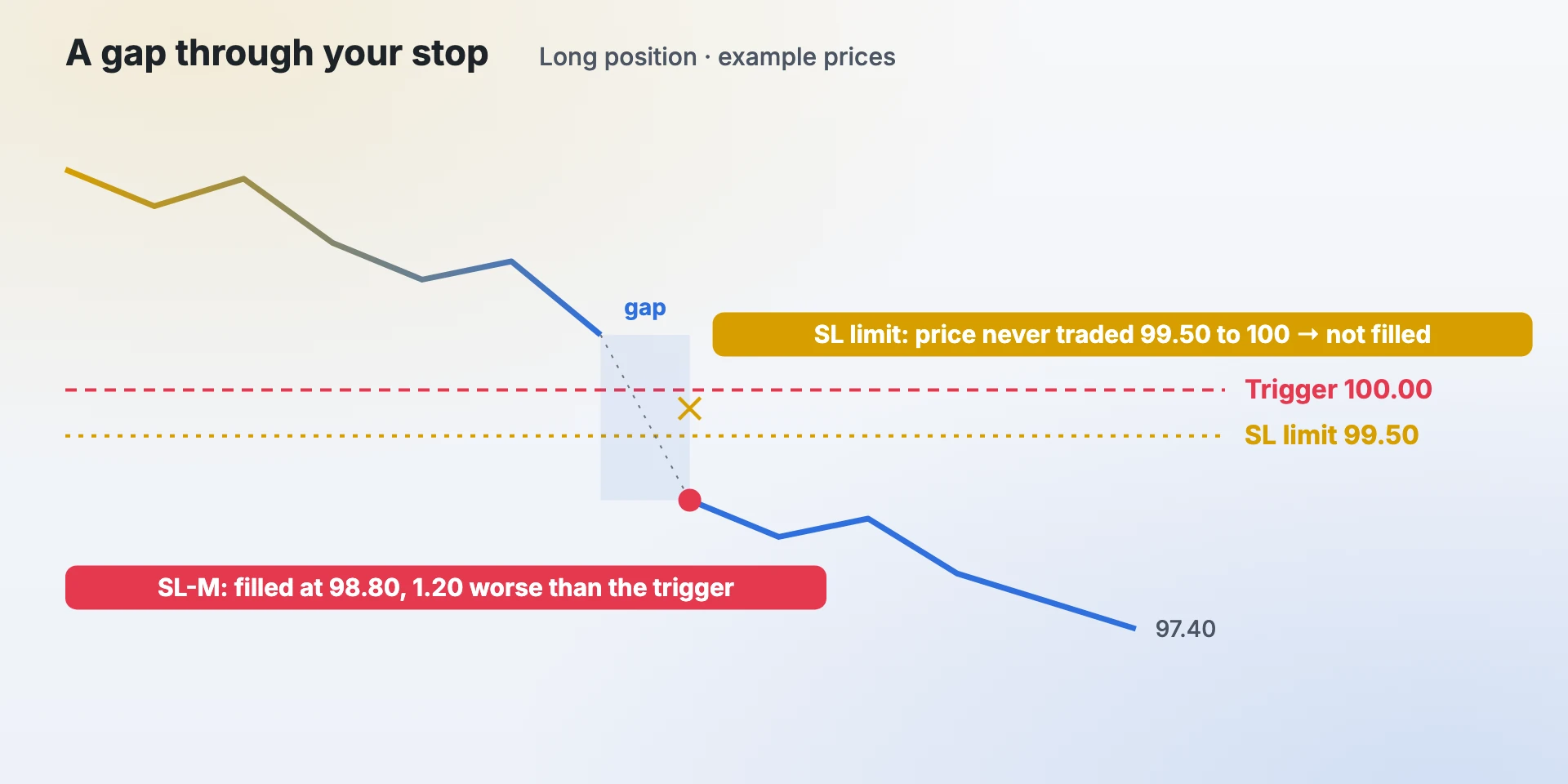
| Stop-loss market (SL-M) | When the trigger price is hit, a market order is sent | Fills at the next available price — can be worse in fast moves or gaps. Some exchanges and brokers don’t allow it for options. |
| Stop-loss limit (SL) | When triggered, a limit order is placed at your limit price | If the price jumps past your limit, it may not fill at all — leave a gap between trigger and limit. |
| Trailing stop | The stop follows the price as the trade moves your way | See trailing stop loss. |
| Mental stop | You exit by hand when the level breaks | Easy to hesitate or move. Use only if you always act on it. |
Also check how long the order lives: some brokers cancel intraday stop-loss orders at the end of the day.
Where to put your stop loss: 5 ways
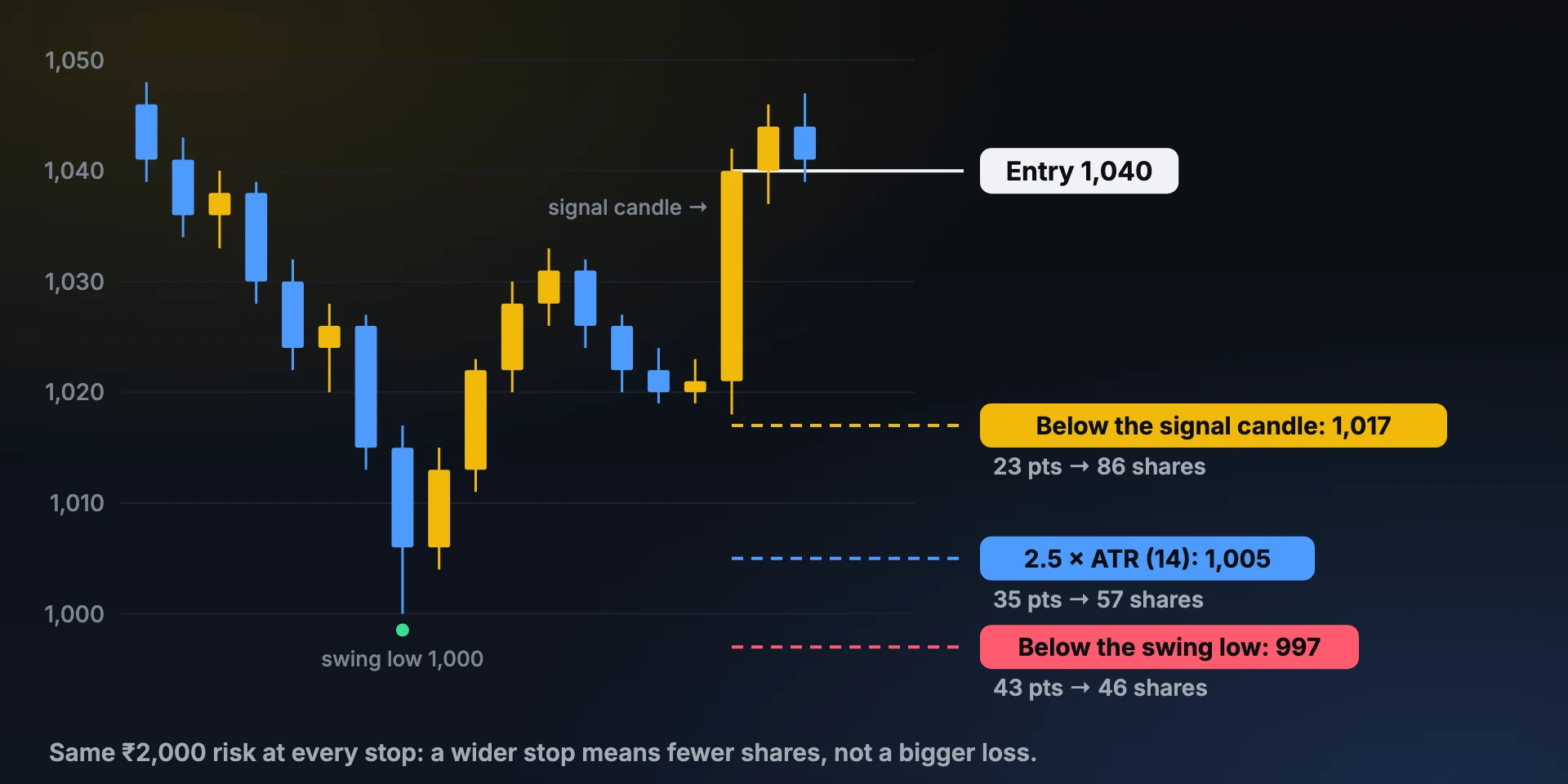
- Where the idea is wrong. Below the support, swing low or range you are trading from (above it for shorts). Ask: “At what price would I admit I was wrong?”
- Beyond the signal candle. Below the low of the candle that triggered a long (above the high for a short). Fast and objective for breakout and momentum trades.
- By volatility (ATR). 1.5–3 × the Average True Range from the entry, so normal noise doesn’t hit it.
- Beyond a moving average or VWAP that the trade depends on.
- Time stop. Exit if the trade hasn’t moved your way after a set number of candles — a stale trade is often a wrong one.
Stop losses on option buys
When you buy an option, you can place the stop on the premium or on the underlying. A premium stop is exact in money: buy the NIFTY 24500 CE at ₹152.50 with a stop at ₹128, and the loss is ₹24.50 × 75 = ₹1,837.50 per lot. A stop on the index level (for example, exit if Nifty closes back below the breakout) matches the chart idea better, but the premium you exit at depends on time decay and volatility too, so the loss in money is less certain. Many option buyers use the chart level to decide and a premium stop as the hard limit at the broker.
Then size the trade from the stop
Decide the stop first, then the quantity: quantity = money at risk ÷ distance to the stop. A wide stop means a smaller position, not a bigger loss. The stop loss calculator and position size calculator do both.
Common stop-loss mistakes
- Too tight to make the position bigger — you get stopped out by noise, and fees eat a large share of each trade.
- Moving the stop further away once in the trade. Move a stop only to reduce risk.
- No stop at all on “sure” trades — the ones that become the biggest losses.
- Same distance for every market, ignoring volatility.
- Re-entering immediately after being stopped out, out of frustration.
How a journal helps
Record the stop you planned and where you actually exited. Over a month the journal shows how often you hit your stop, how often you moved it, and what moved stops cost in R — Profit Prism’s Leaks report flags losses that went past −1R.
Frequently asked questions
What is a stop loss in trading?
A stop loss is a price, decided before entering, at which you exit a losing trade — below the entry for a long and above it for a short — so the loss stays at the amount you planned.
Where should I put my stop loss?
Where the trade idea is clearly wrong: beyond the swing low or high, support or resistance, or the signal candle, or a multiple of ATR away — with a small buffer, then size the position from that distance.
What is the difference between SL and SL-M orders?
An SL (stop-loss limit) order places a limit order when triggered and may not fill if the price jumps past the limit. An SL-M (stop-loss market) order sends a market order when triggered, so it fills but possibly at a worse price.
How far should a stop loss be?
Far enough that normal price noise does not hit it — often 1.5 to 3 times ATR or just beyond a clear chart level — and no further than the point where your trade idea is wrong.
Should I ever move my stop loss?
Only to reduce risk, for example trailing it behind a winning trade. Moving a stop further away to avoid a loss is one of the most common reasons small losses become large ones.
See your own numbers
Profit Prism Journal measures every trade in R and shows your win rate, RR, leaks and loss limits — for crypto, forex, stocks and F&O. Try it free for 7 days, no card.
Start the free trialFor education only. Not investment advice. Trading involves substantial risk of loss.