What is a trailing stop loss?
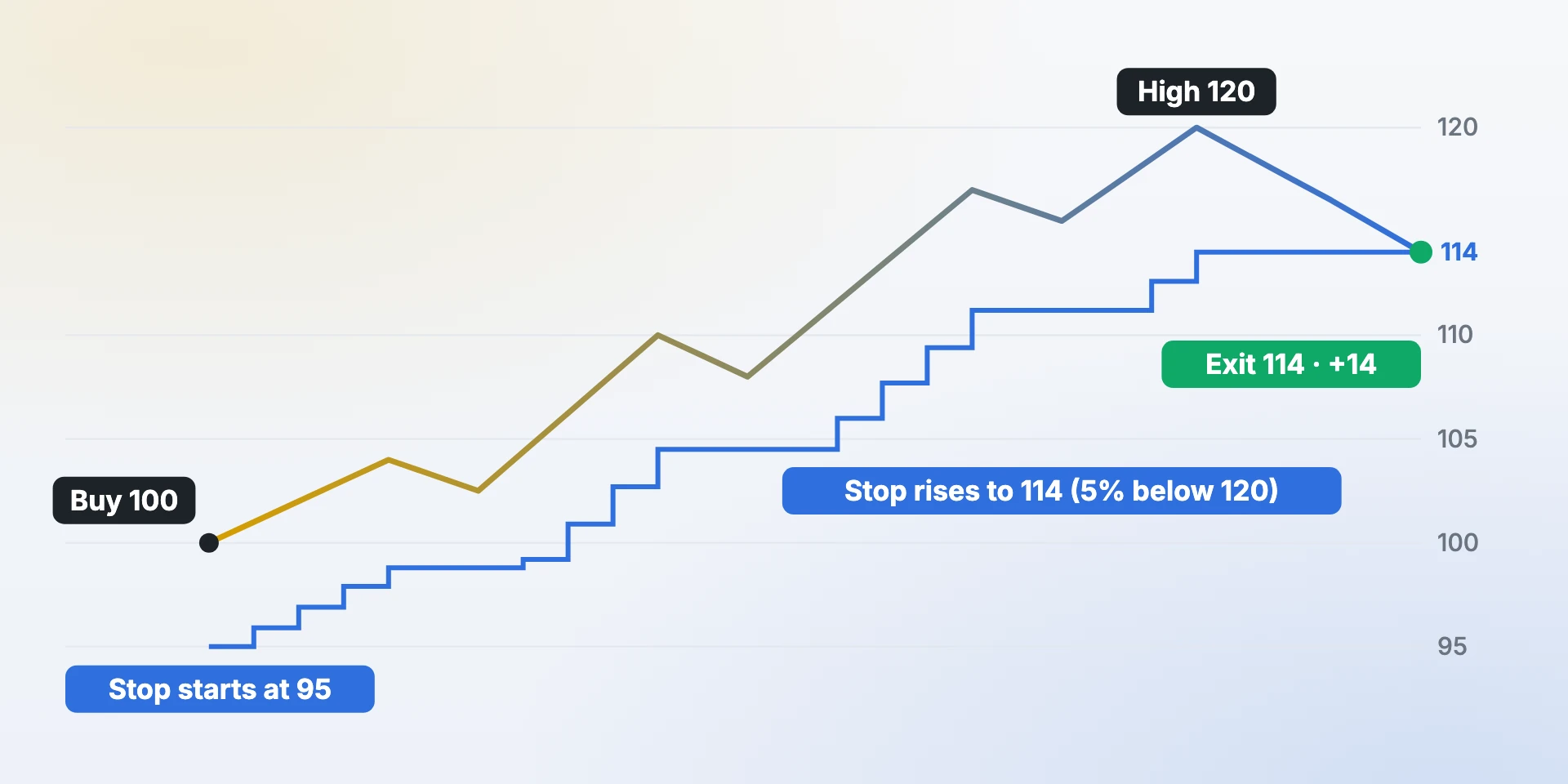
A normal stop loss stays where you put it. A trailing stop follows the price at a distance: for a long trade it rises as the price makes new highs; for a short it falls as the price makes new lows. It never moves against you. If the price turns and hits it, you are out.
How to trail a stop: 5 common methods
1. Fixed percent or points
Keep the stop a set distance behind the best price (5%, 50 points). Simple, but the same distance can be too tight in a fast market and too loose in a slow one.
2. ATR (volatility)
Trail by a multiple of the Average True Range, e.g. 2 × ATR below the highest price. The stop gives more room when the market moves more.
3. Swing lows / highs
Move the stop to just below each new higher low (or above each lower high for shorts). It follows the market’s structure.
4. Moving average
Exit on a close below a moving average such as the 20 EMA. Smooth, but reacts later than a swing stop.
5. Breakeven at 1R, then trail
Move the stop to entry once the trade reaches +1R, then trail with one of the methods above. Removes the risk early, at the cost of more breakeven exits.
A worked example in R
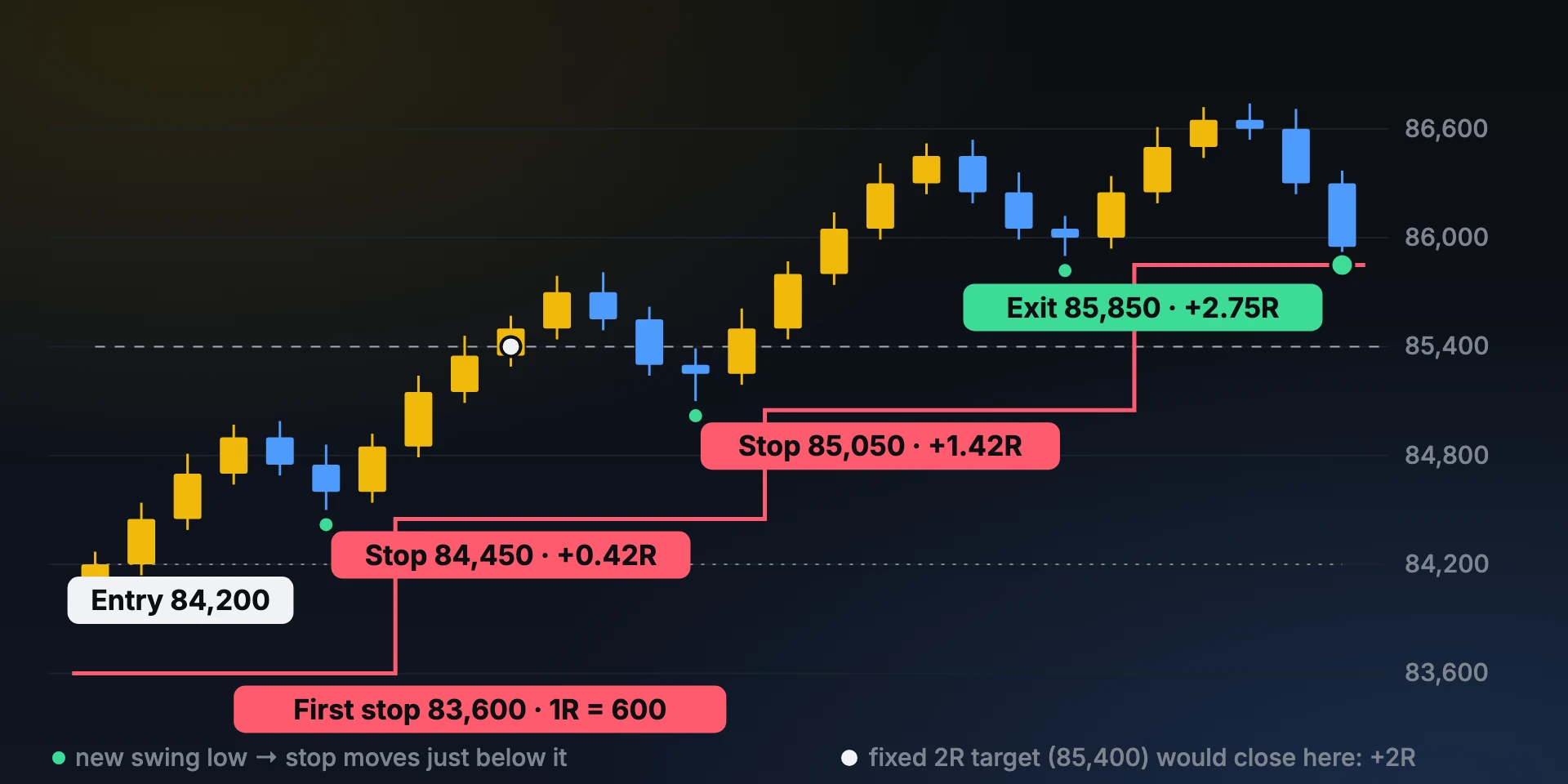
A BTCUSDT long at 84,200 with the first stop at 83,600 risks 600 per coin — that is 1R. The trader trails below each new swing low:
| Price makes a new swing low at | Stop moves to | Locked in |
|---|---|---|
| 84,500 | 84,450 | +0.42R |
| 85,100 | 85,050 | +1.42R |
| 85,900 | 85,850 | +2.75R |
If the price then drops to 85,850 the trade closes at +2.75R. A fixed target at 2R would have closed at 85,400 for +2R — the trail kept the trade open for the rest of the move.
Pros and cons
Why traders use it
Lets big winners run, which is where most of the profit in trend trading comes from. Removes the urge to grab small profits. Rules are clear in advance.
What to watch
Too tight and normal noise stops you out early. It always gives back part of the move. On gaps the exit can be worse than the stop. Fees and slippage matter on tight trails.
Trailing stop orders vs trailing by hand
Some exchanges and brokers offer a trailing stop order that moves automatically by a set amount or percent. Others don’t support it for every product, so many traders trail by hand: after each candle closes they move a normal stop order to the new level. Either way, decide the rule before entering — a trailing stop you change in the moment is just another discretionary exit.
How a journal helps
Record each partial exit and where your stop finally was. Profit Prism Journal keeps every exit with its own R, so after a month you can compare: did trailing give you bigger average winners than fixed targets, and how often did it stop you at breakeven?
Frequently asked questions
What is a trailing stop loss?
A trailing stop loss moves with the price as a trade goes your way — up for a long, down for a short — and never moves back. If the price reverses and hits it, the trade closes, locking in part of the profit.
How does a trailing stop loss work?
You set a distance (a percent, points, an ATR multiple or a chart level). Each time the price makes a new best level, the stop moves to keep that distance; when the price comes back to the stop, you exit.
What is a good trailing stop percentage?
There is no single best value; it depends on the market’s volatility. Many traders use a multiple of ATR (for example 2–3 × ATR) or recent swing levels instead of a fixed percent.
Should I move my stop to breakeven?
Moving to breakeven at +1R removes the risk on a trade but also turns some would-be winners into breakeven exits. Test it on your own journal data before making it a rule.
Can I use a trailing stop in Indian F&O?
Some brokers offer trailing stop orders for some products; where they don’t, traders trail manually by moving a normal stop-loss order after each candle closes.
See your own numbers
Profit Prism Journal measures every trade in R and shows your win rate, RR, leaks and loss limits — for crypto, forex, stocks and F&O. Try it free for 7 days, no card.
Start the free trialFor education only. Not investment advice. Trading involves substantial risk of loss.