Example trading rules
Risk rules
Risk at most 1% per trade. Stop for the day at −3R. Stop for the week at −6R. Never add to a losing position.
Entry rules
Only my written setups. No trades in the first 15 minutes. No trades 10 minutes before major news.
Exit rules
Stop order placed with the entry. Never move a stop further away. Take partial profit at 2R, trail the rest.
Routine rules
Maximum 3 trades a day. 20-minute break after any loss. Journal every trade the same day.
Start with three rules
A list of twenty rules gets ignored. Start with the three that would have saved you the most money last month — your journal usually makes them obvious (moved stops, too many trades, trading after a big loss). Follow those for a month, then add one more.
A daily discipline checklist
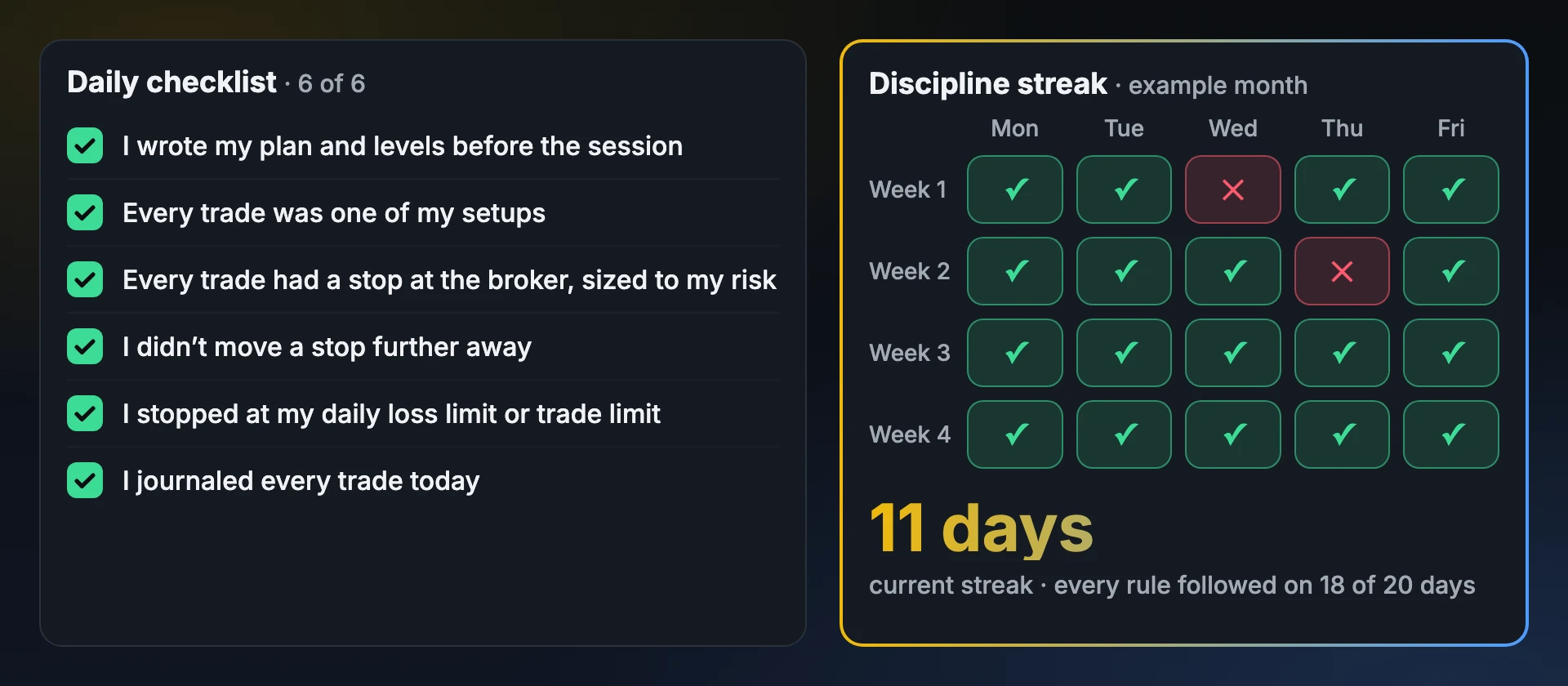
- I wrote my plan and levels before the session.
- Every trade was one of my setups.
- Every trade had a stop at the broker, sized to my risk.
- I didn’t move a stop further away.
- I stopped at my daily loss limit or trade limit.
- I journaled every trade today.
Tick it at the end of each day. A run of fully-ticked days is a discipline streak — and streaks are motivating in a way that P&L, which swings every day, is not.
Measure discipline against results
The strongest argument for discipline is your own data. Compare your average R on days you followed every rule with days you broke at least one. For most traders the gap is large; occasionally it isn’t, and that tells you a rule is wrong and needs changing — which is useful too.
Discipline after a winning streak
Most traders expect rules to break after losses, but a run of wins is just as risky: size creeps up, setups get looser and the stop goes on “later”. Two rules help. Keep the same 1R after five wins in a row as after five losses. And treat the first trade after a big winning day like the first trade after a loss: checklist first, normal size, no “house money”.
When you break a rule
- Write down which rule, what triggered it and what it cost in R.
- Don’t try to fix it with the next trade — stop for the day if you are emotional.
- Look for the pattern weekly: the same rule broken at the same time of day usually has the same cause.
- Make the rule easier to keep (a timer, an alert, a smaller size), not just stricter.
How a journal helps
Profit Prism Journal has a daily rules checklist with a compliance calendar, a discipline streak, and a “discipline vs results” comparison — your average R on fully-compliant days against days with a skipped rule — plus loss limits that warn you before you break them.
Frequently asked questions
What is trading discipline?
Trading discipline is consistently following your written trading plan — setups, risk per trade, stops, exits and daily limits — especially when emotions push you to do something else.
How do I become a disciplined trader?
Write a few clear rules (start with three), check them before and after every session, stop at a daily loss limit, journal every trade, and compare your results on rule-following days with the rest.
What rules should a trader have?
At minimum: a maximum risk per trade, a stop on every trade decided before entry, a daily loss limit, a list of allowed setups, and a maximum number of trades per day.
Why do I break my trading rules?
Common triggers are a recent loss, a big win, boredom and oversized positions. Track when and why each rule is broken; the pattern usually points to a fix such as a cool-off break or smaller size.
How do I measure trading discipline?
Tick a daily rules checklist, track your streak of fully-compliant days, and compare your average R per trade on compliant days with days you broke a rule.
See your own numbers
Profit Prism Journal measures every trade in R and shows your win rate, RR, leaks and loss limits — for crypto, forex, stocks and F&O. Try it free for 7 days, no card.
Start the free trialFor education only. Not investment advice. Trading involves substantial risk of loss.