What to include in a trading plan
| Section | Questions to answer |
|---|---|
| 1. Goals | Why you trade, and a process goal for this quarter (not a money target) |
| 2. Markets and timeframes | Which instruments, which charts, which hours |
| 3. Setups | Each setup with its conditions, entry trigger, stop and exit |
| 4. Risk | Risk per trade, daily and weekly loss limits, maximum open trades |
| 5. Position sizing | How quantity is calculated from the stop |
| 6. Trade management | Partial exits, trailing, breakeven, time stops |
| 7. Routine | Before, during and after the session |
| 8. Review | Daily log, weekly review questions, monthly changes |
Trading plan template (copy and fill in)
Markets: … Timeframes: … Trading hours: …
Setup 1 — name: conditions … · entry trigger … · stop … · exit …
Setup 2 — name: conditions … · entry trigger … · stop … · exit …
Risk per trade: …% (= ₹/$ …) Daily loss limit: −…R Weekly: −…R Max trades/day: …
Sizing: quantity = risk ÷ |entry − stop|, rounded down
Management: partial at …R · trail by … · time stop after … candles
Before session: … After a loss: … End of day: journal every trade
Weekly review: win rate, RR, net R by setup; biggest mistake; one change
A filled-in example
Markets: Nifty and BankNifty options; BTCUSDT in the evening. Timeframe: 5-minute, with 1-hour for direction. Hours: 9:30–11:30 and 13:30–15:00.
Setup — ORB pullback: range of the first 15 minutes breaks with volume; enter on the first pullback that holds the range edge; stop below the pullback low; first target 2R, trail the rest below each 5-minute swing low.
Risk: 1% per trade (₹2,000 on ₹2,00,000), daily limit −3R, weekly −6R, maximum 3 trades a day.
Routine: mark levels by 9:10; 20-minute break after any loss; log trades and the checklist by 16:00.
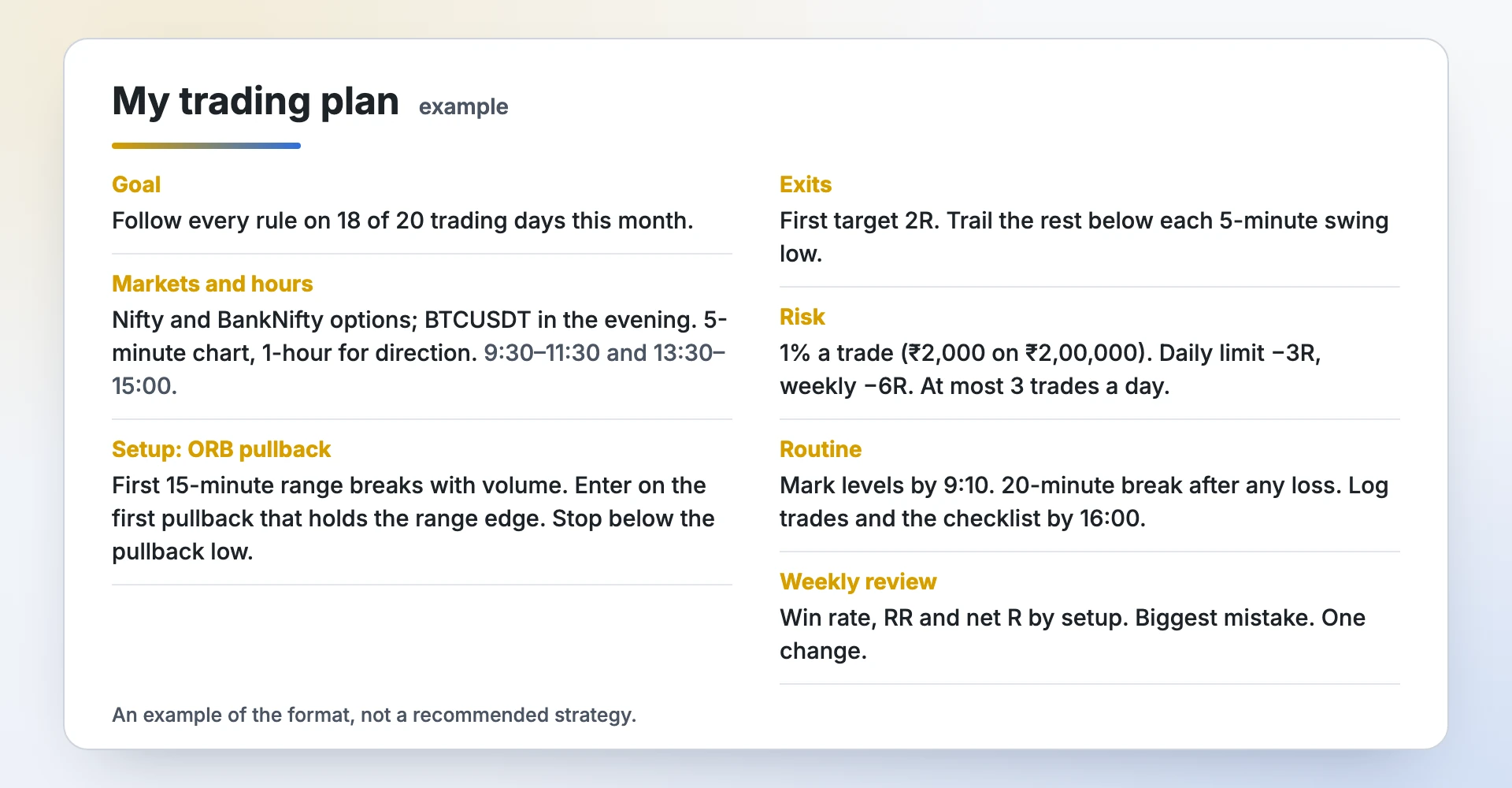
This is an example of the format, not a recommended strategy — your setups should come from your own testing and journal.
Test a setup before it goes in the plan
- Write the rules so someone else could follow them: conditions, entry trigger, stop, exit.
- Find 30–50 past examples on the chart and record each one in R, losers included.
- Check the numbers: win rate, average win and loss in R, and the average R per trade after fees.
- Forward-test at small size for 20 trades, logged in your journal like every other trade.
- Only then add it to the plan, at normal size, and keep tracking it as its own strategy.
Make the plan work
- Keep it to one or two pages; a plan you don’t read doesn’t exist.
- Turn the risk and routine sections into a daily checklist — see trading discipline.
- Change it only at the weekly or monthly review, never in the middle of a session.
- Track each setup separately in your journal, so the plan evolves from evidence.
Frequently asked questions
What is a trading plan?
A written set of rules covering what you trade, when, your setups with entry and exit rules, risk per trade, daily and weekly loss limits, your routine and how you review.
What should a trading plan include?
Goals, markets and timeframes, setups with entry, stop and exit rules, risk per trade and loss limits, position sizing, trade management, a daily routine, and a review process.
How long should a trading plan be?
Short enough to read before every session — usually one or two pages. Detail for each setup can live in a separate playbook.
How often should I update my trading plan?
At a weekly or monthly review, based on your journal data — not during a trading session or after a single bad day.
Is there a trading plan template I can use?
Yes — copy the template on this page and fill in each line. For logging the trades themselves, use our free trading journal template for Excel and Google Sheets.
See your own numbers
Profit Prism Journal measures every trade in R and shows your win rate, RR, leaks and loss limits — for crypto, forex, stocks and F&O. Try it free for 7 days, no card.
Start the free trialFor education only. Not investment advice. Trading involves substantial risk of loss.