What is revenge trading?
You take a loss. It stings. Within minutes you are back in — maybe with double the size, maybe in a market you weren’t watching, maybe against the trend you just got stopped out of. The goal is no longer a good trade; it is to make the loss disappear. That is revenge trading.
Why it happens
- Losses hurt more than gains feel good. A ₹2,000 loss feels bigger than a ₹2,000 win, so the urge to cancel it is strong.
- Ego. “The market was wrong, not me” — so you prove it right now.
- A daily target. If the day must end green, every loss creates pressure to force the next trade.
- Speed. Intraday and crypto markets give you a new chance every minute — and no time to cool down.
Warning signs
- You enter again within minutes of a stop-out.
- Your size is bigger than your normal risk “to make it back”.
- You can’t name the setup for the new trade.
- You move or remove the stop on the new trade.
- You pass your daily loss limit and keep going.
- You think in money (“I need ₹2,000 back”) instead of in setups.
What it costs, in numbers
Measure trades in R (profit ÷ risk) and revenge trading shows up immediately. Compare two traders with the same strategy and the same first loss:
| Trader A — stops after the loss | Trader B — revenge trades | |
|---|---|---|
| Trade 1 | −1R (stop hit) | −1R (stop hit) |
| Trade 2 | — | −2R (double size, no setup) |
| Trade 3 | — | −1R |
| Day | −1R | −4R |
| Wins needed at +2R to recover | 1 | 2 |
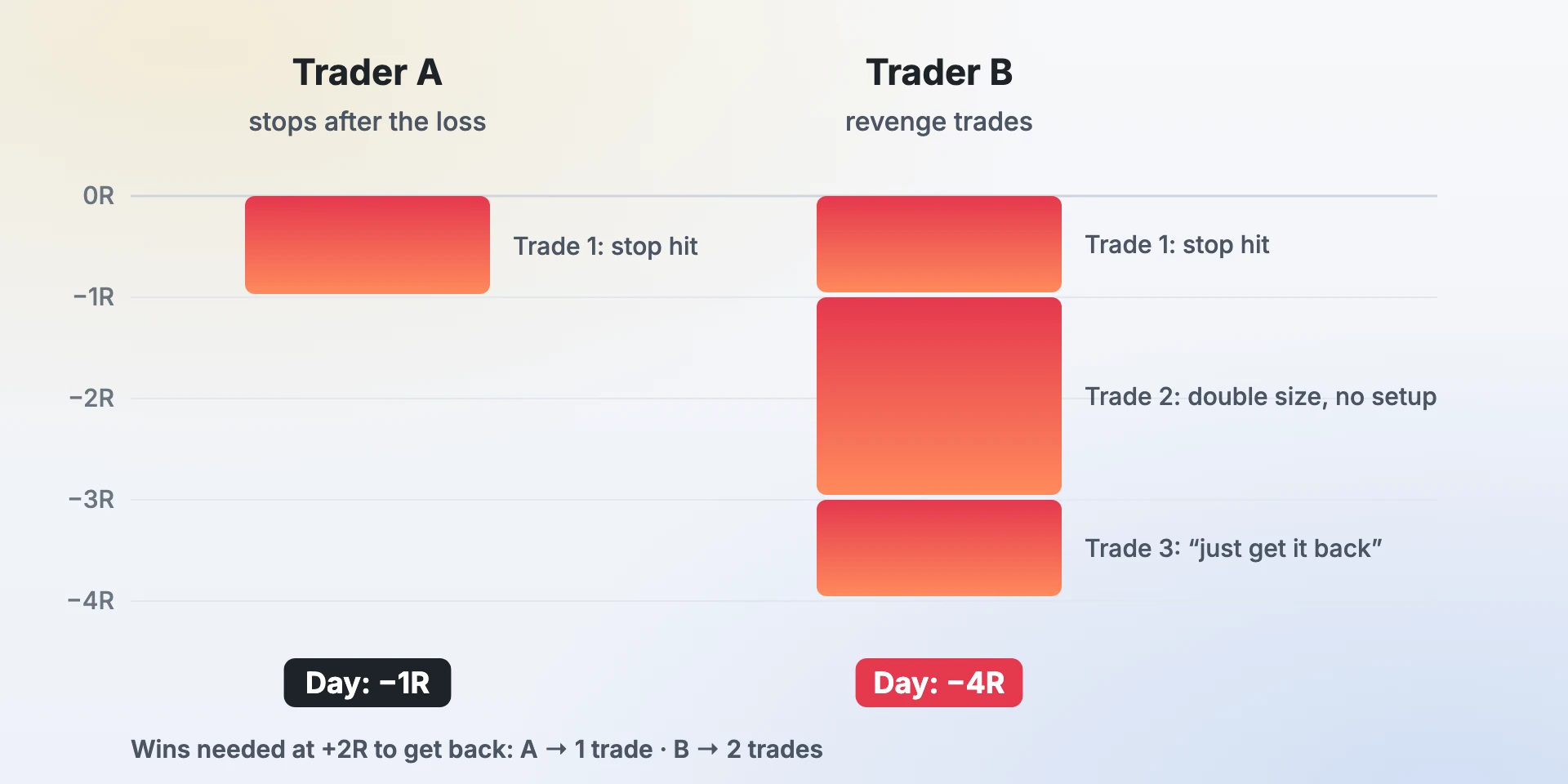
Do that twice a month and a strategy that makes +0.3R a trade over 40 trades (+12R) gives back half of it in two mornings.
How to stop revenge trading: 7 rules
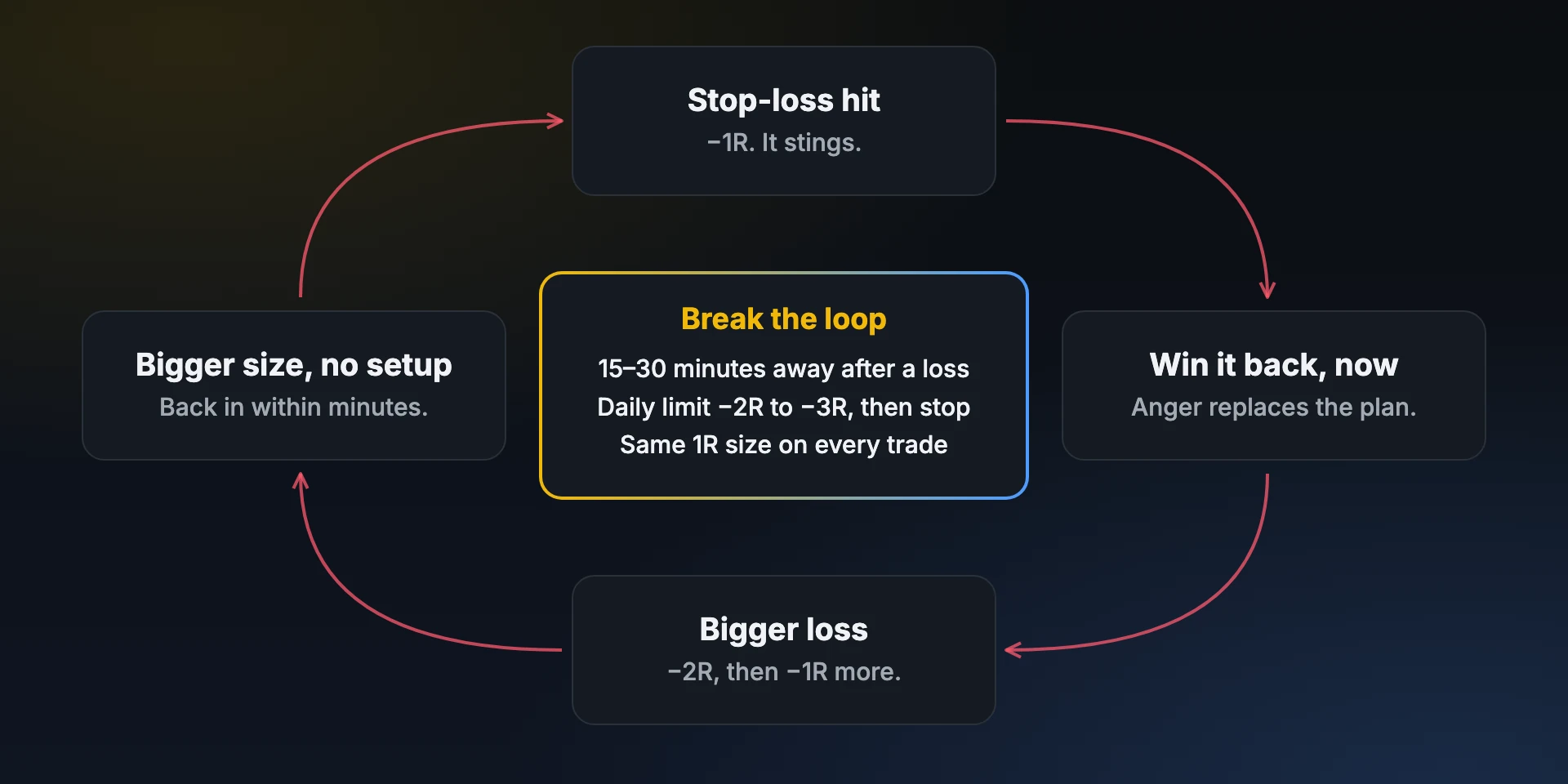
- Set a daily loss limit in R — and stop at it. For example −2R or −3R. When it’s hit, the platform closes for the day. No exceptions.
- Take a cool-off after every loss. 15–30 minutes away from the screen. Most revenge trades happen in the first five.
- Fix your size. Every trade risks the same 1R. Never increase size after a loss.
- Use a pre-trade checklist. If you can’t tick “setup, stop, target, size”, there is no trade.
- Tag your mood. Mark trades taken in anger or frustration as “Revenge” in your journal.
- Review revenge trades weekly. When you see their average R in black and white — usually well below your normal trades — the urge fades.
- End the day on a process, not a number. A good day is one where you followed your rules, even if it was red.
The day after a revenge-trading day
The next session is when the damage either stops or doubles. A simple reset:
- Trade half size for your first three trades. If your normal 1R is ₹2,000, risk ₹1,000 until you have three trades that followed the plan.
- Write down what happened before the market opens: the trigger, each trade and its R, and the rule you broke.
- Lower the daily limit for one day, for example to −1.5R, so one more slip can’t turn into another −4R day.
- Don’t set a target to win it back. The −4R is already in your numbers; the goal today is a clean process.
How a journal helps
In Profit Prism Journal you tag each trade’s mood (Revenge, FOMO, Calm…), and the Leaks report ranks the patterns costing you R — including “after a loss the same day”. Daily and weekly loss limits in R show a warning banner before you go past them, and the discipline checklist keeps your rules in front of you every morning.
Frequently asked questions
What is revenge trading?
Revenge trading is taking a new trade mainly to win back money you just lost — usually with bigger size, less patience and no real setup. It often turns one normal loss into several.
How do I stop revenge trading?
Set a daily loss limit in R and stop when it is hit, take a 15–30 minute break after every loss, keep your size fixed, use a pre-trade checklist, and review your revenge-tagged trades every week.
Is revenge trading the same as overtrading?
They overlap. Overtrading is taking too many or too large trades for any reason (boredom, FOMO, chasing a target); revenge trading is the specific case where the trigger is a recent loss.
How long should I stop trading after a loss?
Long enough for the emotion to pass — many traders use 15–30 minutes after any loss and stop for the day after hitting their daily loss limit or two to three losses in a row.
What daily loss limit should I use?
Many traders use −2R to −3R a day, where 1R is the risk of one trade. The exact number matters less than stopping every single time it is reached.
See your own numbers
Profit Prism Journal measures every trade in R and shows your win rate, RR, leaks and loss limits — for crypto, forex, stocks and F&O. Try it free for 7 days, no card.
Start the free trialFor education only. Not investment advice. Trading involves substantial risk of loss.